April 1, 2026 · 9 min read
Rolex Datejust vs Day-Date: What's the Real Difference?
A detailed comparison of the Rolex Datejust and Day-Date covering materials, sizing, bracelets, dial options, and which one is right for your budget and lifestyle.
The Datejust and the Day-Date are two of the most iconic watches Rolex has ever produced. They look similar at first glance, share the same general DNA, and both sit comfortably in the "dress watch" category. But they serve very different purposes, target different buyers, and sit at completely different price points. If you are trying to decide between them, here is what actually matters.
A Brief History of Each Watch
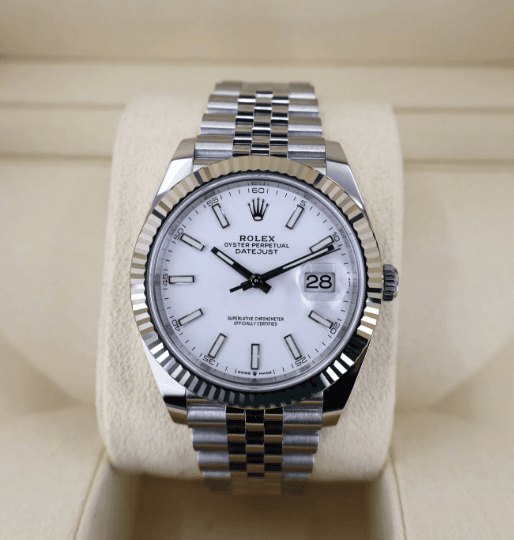
The Datejust came first, launched in 1945 as the world's first wristwatch with an automatically changing date display. It was revolutionary at the time and quickly became Rolex's best-selling model. The design has evolved over the decades, but the core concept has stayed the same: a refined, versatile watch with a date window at 3 o'clock.
The Day-Date followed in 1956 with an additional complication: a full day-of-the-week display spelled out across the top of the dial at 12 o'clock. This was the first wristwatch to show both the date and the day in full text. From the beginning, Rolex made a critical decision that still holds today. The Day-Date would only be produced in precious metals. No steel version has ever existed.
The Biggest Difference: Materials
This is the single most important distinction between these two watches. The Datejust is available in stainless steel (Oystersteel), two-tone combinations (steel and gold), and full precious metal configurations. The Day-Date is exclusively available in 18k yellow gold, white gold, Everose gold (Rolex's proprietary rose gold alloy), or platinum.
That means the entry price for a Day-Date is significantly higher than the entry price for a Datejust. A steel Datejust 36 with a simple dial starts around the mid-$7,000 range at retail. The least expensive Day-Date 36 in 18k yellow gold starts north of $35,000 at retail. That is not a small gap.
Size Options
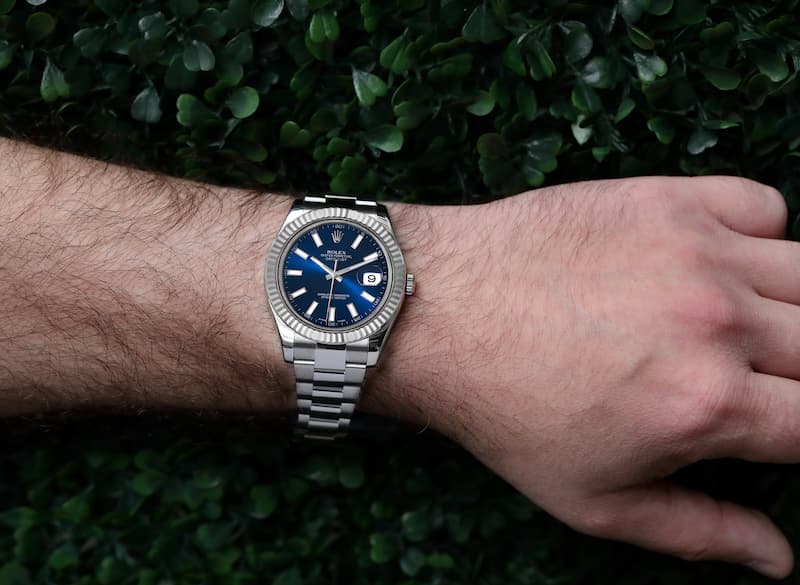
The Datejust currently comes in three sizes: 31mm, 36mm, and 41mm. The 36mm is the classic, the 41mm is the modern standard for larger wrists, and the 31mm is typically marketed toward women (though anyone can wear any size they prefer).
The Day-Date comes in two sizes: 36mm and 40mm. There is no 31mm Day-Date. The 36mm Day-Date is the classic "Presidential" size, and the 40mm version was introduced more recently to match modern sizing trends.
The Bracelet Question
Both watches can be fitted on different bracelets, but the Day-Date is most closely associated with the President bracelet. This semi-circular three-link design was created specifically for the Day-Date and has become so synonymous with the watch that many people simply call the Day-Date the "Presidential" or the "Rolex President."
The Datejust is traditionally paired with the Jubilee bracelet, a five-link design that is comfortable and elegant. It can also be ordered on the Oyster bracelet for a sportier look. In recent years, Rolex has also offered the Datejust on a leather strap, though this option has become less common.
Dial Variety
Both models offer a wide range of dial options, but the Day-Date takes this to another level. Because it is a precious metal watch, Rolex offers dial materials and finishes on the Day-Date that you simply cannot get on a Datejust. These include stone dials (malachite, lapis lazuli, onyx, meteorite), wood dials, and highly decorated enamel dials.
The Datejust has plenty of variety too. Fluted motif dials, palm motif dials, and diamond-set options are all available. But the truly exotic dial materials tend to be reserved for the Day-Date lineup.
Movement Differences
The current Datejust 36 uses the Caliber 3235, and the Datejust 41 also uses the 3235. The Day-Date 36 runs on the Caliber 3255, while the Day-Date 40 uses the 3255 as well. Both movements feature Rolex's Chronergy escapement and a 70-hour power reserve.
The key difference is that the Day-Date movements include the additional mechanism for the day display. This instantaneous day-change complication switches at midnight along with the date, and the day is available in 26 different languages depending on the configuration.
Who Wears What
The Day-Date has a long history with world leaders, executives, and celebrities. It earned the "President's Watch" nickname because multiple U.S. presidents have worn it. Lyndon B. Johnson received one of the earliest examples. The watch communicates a certain level of success and formality.
The Datejust is more democratic. It has been worn by everyone from Wall Street bankers to college graduates celebrating their first real job. Its versatility is its greatest strength. A steel Datejust works with a suit, with jeans, and with just about everything in between.
Resale and Value Retention
Both models hold value well by general watch standards, but the dynamics are different. The Datejust in steel or two-tone tends to be more liquid on the secondary market because more buyers can afford it. Certain configurations (like the Wimbledon dial or fluted bezel on Jubilee) command premiums above retail.
The Day-Date can also hold value, but precious metal watches generally depreciate more than steel models in the short term. The exception is platinum Day-Dates and rare dial variants, which can appreciate significantly over time. If you are buying for value retention specifically, the Datejust in steel is the safer play.
Which One Should You Choose?
If you want a versatile daily watch that works in almost any situation and does not require a luxury-tier budget, the Datejust is the clear choice. It is one of the most well-rounded watches ever made, and there is a reason it remains Rolex's best seller year after year.
If you want a statement piece in precious metal, you value the day complication, and the budget is not a constraint, the Day-Date is in a class of its own. Nothing else in the Rolex lineup carries quite the same weight and heritage.
Neither choice is wrong. They are simply built for different stages of life, different budgets, and different intentions. Understanding those differences is what separates a confident buyer from someone who ends up with the wrong watch on their wrist.
For a deeper look at the Day-Date's heritage and dial options, read our complete Day-Date President guide. If the Datejust catches your eye, see how it compares to the simpler Oyster Perpetual. And for help choosing the right bracelet, check our guide to Rolex bracelet types.
Think You Know Rolex?
Put your knowledge to the test with the free 12-question Chronodex challenge. No account required. See how you rank against thousands of other enthusiasts.
Take the Free ChallengeThis article is for educational purposes only. Chronodex is not affiliated with, endorsed by, or sponsored by Rolex SA, Rolex USA, or any of their subsidiaries. All brand names are used for educational and identification purposes only.