July 15, 2026 · 9 min read
The Rolex Day-Date: Why They Call It the President's Watch
A deep dive into the Rolex Day-Date, from its presidential heritage and precious metal exclusivity to dial variety, sizes, and what makes it a collector favorite.
The Rolex Day-Date, introduced in 1956, was the first wristwatch to display both the day of the week (spelled out in full) and the date on the dial. From the beginning, it has only been produced in precious metals: 18k yellow gold, 18k white gold, 18k Everose gold, or 950 platinum. This exclusivity, combined with its association with presidents, world leaders, and cultural icons, earned it the nickname that has stuck for nearly seven decades: the President.
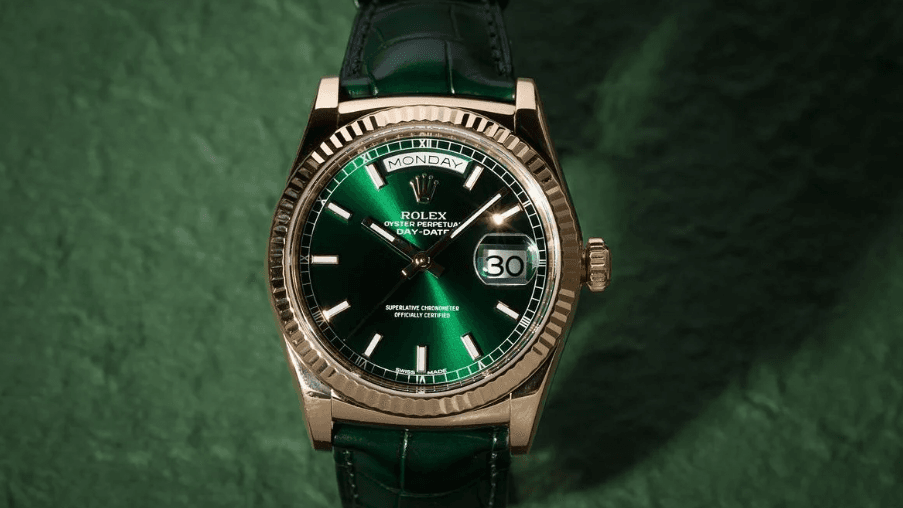
Why "The President's Watch"?
The association with U.S. presidents began with Dwight D. Eisenhower, who received a gold Rolex Datejust (the 150,000th chronometer- certified Rolex) in 1956. When the Day-Date launched that same year with its distinctive semi-circular link bracelet, Rolex began calling the bracelet the "President" bracelet. Over time, the name extended to the watch itself.
Lyndon B. Johnson was photographed wearing a Day-Date. So were numerous other world leaders, diplomats, and heads of state around the globe. The watch became a symbol of achievement and authority in political, business, and entertainment circles. It appeared on the wrists of Martin Luther King Jr., who reportedly received one as a gift, and countless other influential figures throughout the 20th century.
The President Bracelet
The President bracelet is exclusive to the Day-Date (and the Lady-Datejust in precious metals). It features semi-circular three-piece links that give it a distinctive, flowing appearance on the wrist. The bracelet has evolved over the decades, gaining more refinement in link finishing and an improved clasp system.
Modern versions feature the Crownclasp, a concealed folding clasp beneath the center link that maintains the bracelet's clean aesthetic. The bracelet is extremely comfortable, draping across the wrist with a suppleness that the Oyster and Jubilee bracelets do not quite match. Because it is made entirely of precious metal, it also has a satisfying heft that immediately communicates quality.
Day-Date Sizes: 36mm and 40mm
The original Day-Date was 36mm, a size that remained standard for decades. In 2008, Rolex introduced the Day-Date II at 41mm, which was later refined into the Day-Date 40 in 2015. The 40mm version uses the Caliber 3255 movement, one of Rolex's most advanced, with a 70-hour power reserve, Chronergy escapement, and Parachrom hairspring.
The 36mm Day-Date remains in production alongside the 40mm, giving buyers a genuine choice. Vintage collectors tend to prefer the 36mm for its classic proportions and historical significance. Modern buyers often gravitate toward the 40mm for its larger presence on the wrist and updated movement technology. Both sizes are available in all four precious metal options.
Dial Variety
No Rolex model offers more dial variety than the Day-Date. Beyond standard sunburst colors in champagne, silver, blue, green, and black, Rolex produces the Day-Date with stone dials (malachite, lapis lazuli, onyx, meteorite, tiger's eye), enamel dials, paved diamond dials, and other exotic materials. These special dials are typically limited in production and can command significant premiums on the secondary market.
The day display itself is available in over 26 languages. The standard configuration shows the day in English, but buyers can request Arabic, Chinese, Hebrew, Japanese, and many other languages when ordering through an authorized dealer. This level of personalization is unique to the Day-Date within the Rolex catalog.
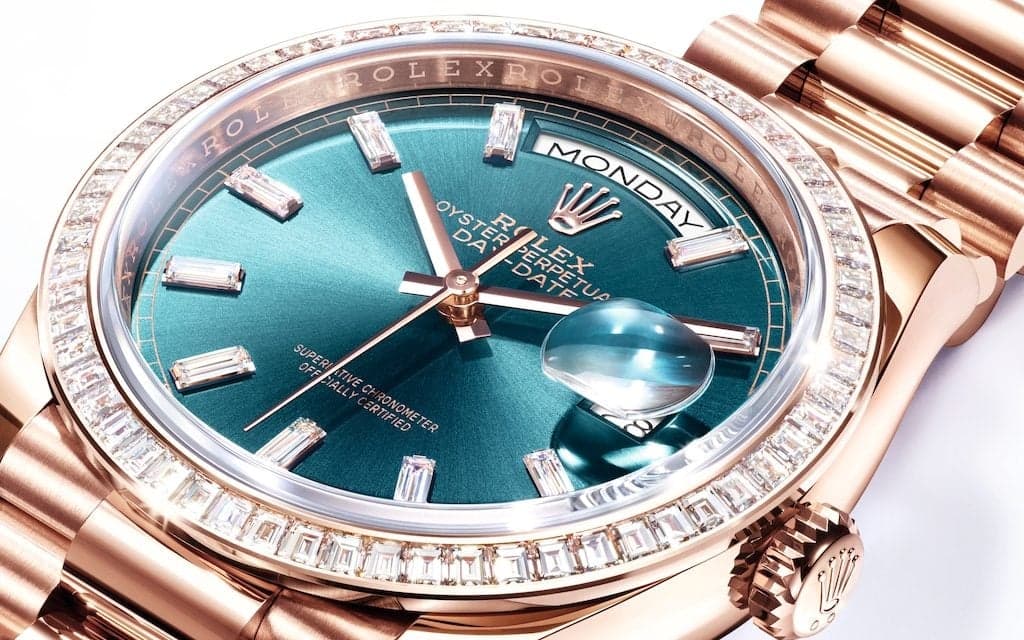
Materials: Yellow Gold, White Gold, Everose, and Platinum
Each metal gives the Day-Date a distinctly different character. Yellow gold is the classic choice, the one most associated with the presidential image. White gold offers a more understated, modern look that can be mistaken for steel at a glance (though the weight gives it away immediately). Everose is Rolex's proprietary pink gold alloy, blended with a small percentage of platinum to resist fading. Platinum is the rarest and most expensive option, identified by its slightly gray tone and smooth, domed bezel rather than the fluted bezel standard on gold versions.
The platinum Day-Date also features an ice blue dial that is exclusive to platinum Rolex models. This dial color has become a strong identifier and collector favorite. If you see a Day-Date with an ice blue dial, you know it is platinum.
Vintage Day-Date: The 1803 and 18038
Vintage Day-Date references from the 1960s through the 1980s have become increasingly collectible. The ref. 1803 (produced from the late 1950s through the 1970s) is popular for its acrylic crystal, pie-pan dial configuration, and slim profile. The ref. 18038 (1970s through 1980s) introduced the sapphire crystal and quick-set date mechanism. Both references can be found at prices well below current retail for a new Day-Date, making them attractive entry points into precious metal Rolex ownership.
When buying vintage, pay close attention to case condition. Gold is softer than steel, and decades of wear, polishing, and contact can thin the case and erode details on the lugs and bezel. An over-polished vintage Day-Date will have rounded edges where there should be crisp lines. Original bracelets on vintage models also tend to show significant stretch, and replacement President bracelets are expensive.
Is the Day-Date Worth the Premium?
The Day-Date is significantly more expensive than steel Rolex sports models because it is made entirely of precious metal. The gold content alone accounts for a substantial portion of the retail price. Whether it is "worth it" depends on what you value. If you want a watch with historical gravitas, unmatched dial variety, and the undeniable presence of solid gold or platinum on your wrist, no other Rolex delivers quite like the Day-Date.
As an investment, the Day-Date in yellow gold has shown steady appreciation over long holding periods, particularly for vintage references with desirable dial configurations. It does not spike in value the way a steel Daytona might, but the precious metal content provides a floor that protects against dramatic depreciation. For the buyer who wants substance, heritage, and exclusivity in a single watch, the President remains in a category of its own.
Think You Know Rolex?
Put your knowledge to the test with the free 12-question Chronodex challenge. No account required. See how you rank against thousands of other enthusiasts.
Take the Free ChallengeThis article is for educational purposes only. Chronodex is not affiliated with, endorsed by, or sponsored by Rolex SA, Rolex USA, or any of their subsidiaries. All brand names are used for educational and identification purposes only.