July 8, 2026 · 8 min read
Rolex Oyster Perpetual: The Best Entry Point Into Rolex
Everything you need to know about the Rolex Oyster Perpetual, including sizes, dial colors, pricing, and why it is the smartest first Rolex for most buyers.
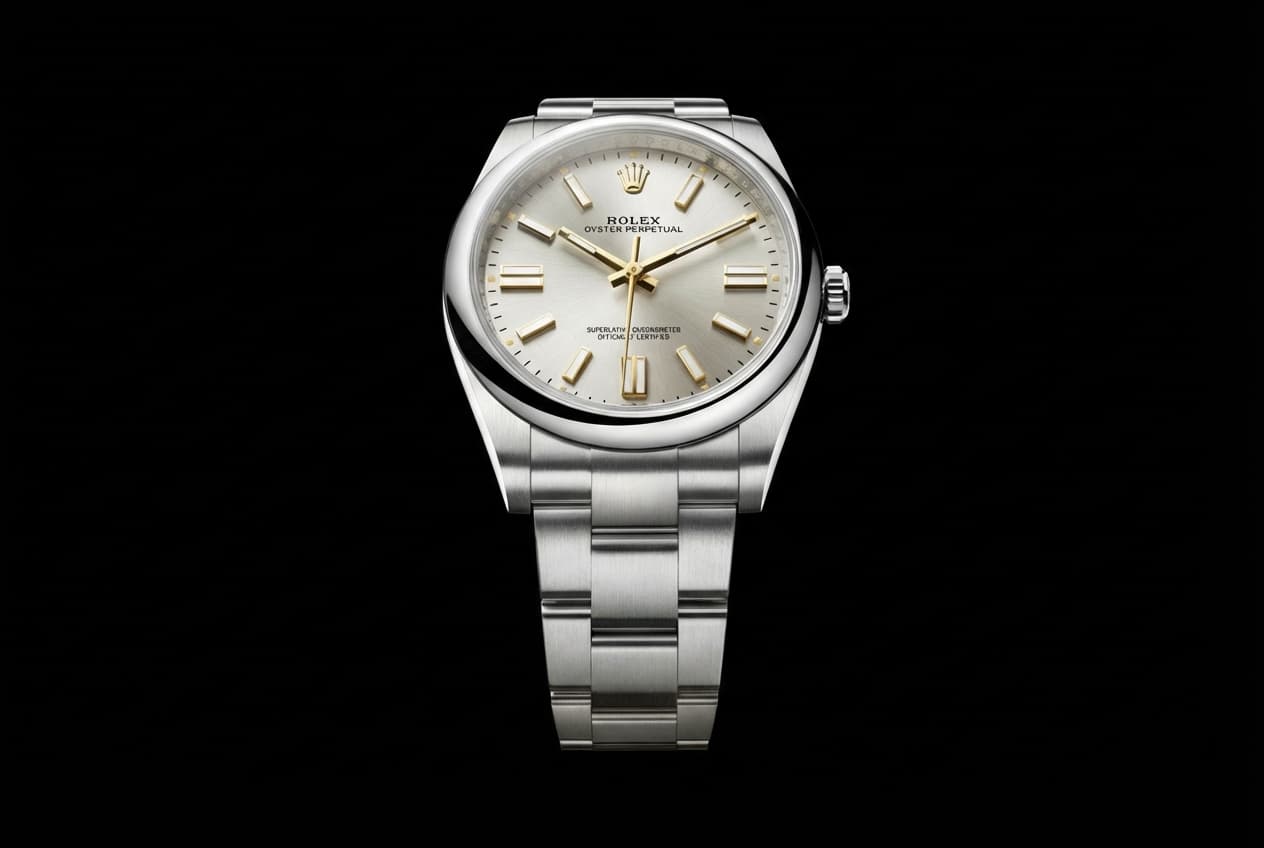
Strip away the date window, the rotating bezel, the chronograph pushers, the GMT hand, and everything else Rolex bolts onto their watches. What you are left with is the Oyster Perpetual: a waterproof case, a self-winding movement, and time. Nothing more. It carries the two innovations that made Rolex the most recognized watch brand on the planet, and it costs less than any other watch in the catalog. For a lot of first-time buyers, that combination makes it the smartest entry point into Rolex ownership.
Two Inventions That Changed Everything
The name says it all. "Oyster" refers to the waterproof case Rolex patented in 1926, which was proven to the public in dramatic fashion when Mercedes Gleitze wore one while swimming the English Channel in 1927. Before the Oyster, wristwatches were fragile instruments that feared rain. After it, waterproofing became the standard every watchmaker chased.
"Perpetual" refers to the self-winding rotor mechanism Rolex introduced in 1931. Instead of requiring the wearer to manually wind the watch each day, a weighted rotor inside the case spins with the motion of the wrist, keeping the mainspring wound automatically. These two technologies became the foundation for every single Rolex produced since: the Submariner, the Daytona, the GMT-Master, all of them. The Oyster Perpetual is the purest expression of that foundation with nothing added on top.
What You Get (and What You Do Not)
The Oyster Perpetual tells the time. That is it. No date window means no cyclops magnifier disrupting the dial symmetry. No bezel complications means a smooth, fixed bezel that frames the dial cleanly. No chronograph pushers means a case that slips under any shirt cuff without snagging. The result is a perfectly symmetrical dial that many collectors consider one of the most visually balanced in the entire Rolex lineup.
From a practical standpoint, no date also means one less thing to set when you pick the watch up after a few days off the wrist, and one less component that could eventually need service. It is simplicity as a feature, not a compromise.
Sizes and Who They Fit
Rolex currently produces the Oyster Perpetual in five sizes: 28mm, 31mm, 34mm, 36mm, and 41mm. The 36mm and 41mm are the most popular among adult buyers. The 36mm is the classic Rolex size that has worked on wrists for eight decades. The 41mm suits modern preferences for slightly larger watches without crossing into oversized territory.
The 36mm and 41mm versions both use the Caliber 3230, which delivers a 70-hour power reserve, the Chronergy escapement, and the Parachrom hairspring. The smaller sizes use the Caliber 2232 with a 55-hour reserve. Every size carries COSC chronometer certification and Rolex's in-house Superlative Chronometer standard of plus or minus two seconds per day.
The Dial Color Story
This is where the Oyster Perpetual gets interesting. Starting around 2020, Rolex began releasing the OP in eye-catching colors that nobody expected: turquoise blue, coral red, bright yellow, and candy pink. The turquoise dial in particular (which collectors immediately started calling "Tiffany Blue," a name Rolex never uses) became a phenomenon. Secondary market prices for the 41mm turquoise dial topped $20,000, roughly three times retail, during peak demand.
What makes the color story relevant beyond hype is that Rolex can discontinue any dial color at any time, without warning or explanation. When they pulled the candy pink and bright yellow from certain sizes, remaining examples immediately became more desirable. This pattern means even a "basic" Oyster Perpetual can become a collector piece overnight if Rolex decides to retire its color.
Standard colors like black, silver, and blue tend to be more available at authorized dealers and trade closer to retail. If you want the watch to wear and enjoy without paying a premium, classic colors are the practical choice. If you are willing to wait or pay above retail, the statement colors offer both visual impact and potential long-term collectibility.
Oyster Perpetual vs. Datejust: The Real Comparison
First-time buyers almost always ask: should I get the Oyster Perpetual or the Datejust? The Datejust adds a date window with cyclops magnification and offers far more customization: fluted or smooth bezel, Jubilee or Oyster bracelet, and dozens of dial combinations including fluted motif and palm motif textures.
The Datejust also starts roughly $1,500 to $2,000 higher at retail, and the price climbs quickly with fluted bezels and Jubilee bracelets. A configured Datejust 41 can easily cost 50 percent more than an Oyster Perpetual 41.
Choose the Oyster Perpetual if you want a clean, symmetrical dial, the lowest possible entry price, and simplicity. Choose the Datejust if you want the date function, more configuration options, and a slightly dressier look. Both share the same Oyster case platform and movement technology. The difference is aesthetics and personal preference.
Buying Tips
At authorized dealers, the Oyster Perpetual is generally easier to purchase than sports models. Standard dial colors in smaller sizes are sometimes available on the spot. The 36mm and 41mm in popular colors may involve some wait time, but nothing close to a Submariner or Daytona. On the secondary market, standard configurations trade at or slightly below retail, while discontinued or unusual dial colors can carry premiums.
When buying pre-owned, check that the dial, hands, and crystal are original. The Oyster Perpetual has a simple design, so any modifications or replacements tend to be easy to spot with a loupe. Verify the warranty card date against the serial number range to confirm the watch has not been assembled from mismatched parts.
The Foundation of Everything
The Oyster Perpetual does not get the magazine covers, the auction records, or the celebrity endorsements. What it gets is the DNA of every great Rolex ever made, in the most distilled and affordable form available. If you want to understand what Rolex is fundamentally about, before the complications and the precious metals and the waitlists, this is the watch that tells you.
For a deeper comparison with the Datejust, read our Datejust vs Day-Date guide. If you are interested in how this watch's movement works, see every Rolex caliber explained. And for sizing guidance, check our best Rolex for small wrists.
Think You Know Rolex?
Put your knowledge to the test with the free 12-question Chronodex challenge. No account required. See how you rank against thousands of other enthusiasts.
Take the Free ChallengeThis article is for educational purposes only. Chronodex is not affiliated with, endorsed by, or sponsored by Rolex SA, Rolex USA, or any of their subsidiaries. All brand names are used for educational and identification purposes only.