August 12, 2026 · 8 min read
Rolex Bracelet Types: Jubilee, Oyster, President, and Oysterflex Compared
Compare the four main Rolex bracelet types including the Jubilee, Oyster, President, and Oysterflex, covering design, comfort, availability, and how each affects resale value.
The bracelet on a Rolex is not an afterthought. It is roughly 40 percent of the watch by weight, it is the part that touches your skin all day, and on the secondary market it can swing a watch's price by thousands of dollars. The same GMT-Master II ref. 126710BLNR on a Jubilee bracelet trades at a different price than the same reference on an Oyster. Understanding the four main Rolex bracelet types, and how each one changes the character of the watch it is attached to, is essential knowledge for any buyer.
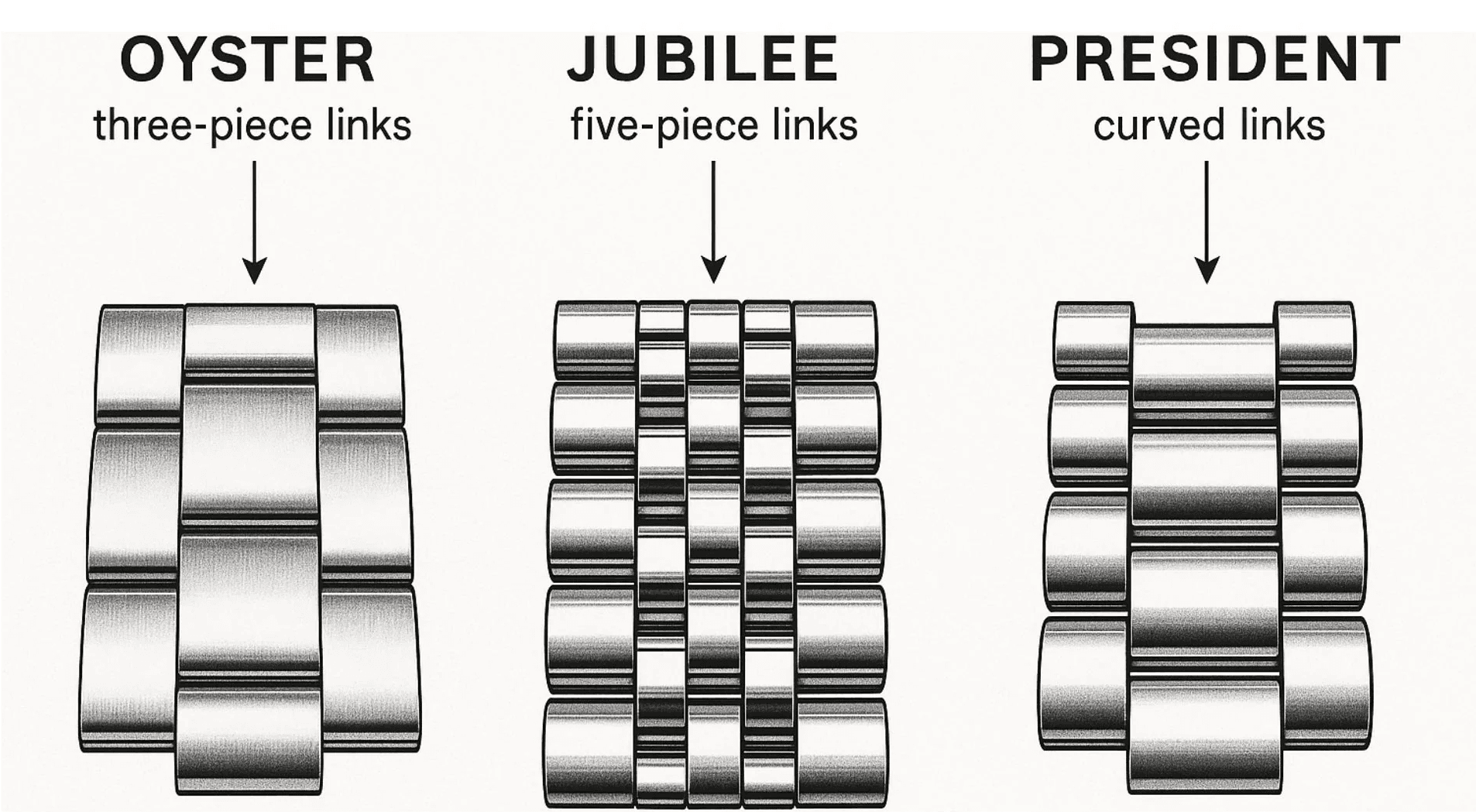
The Oyster Bracelet: Built for Everything
The Oyster is the most common bracelet in the Rolex lineup and the one most people picture when they think of a Rolex watch. Three flat links per row create a clean, robust appearance that works in virtually any context: boardroom, beach, workshop, restaurant. It has been in production since 1947, though modern versions bear little resemblance to the original in terms of construction quality.
Current-production Oyster bracelets feature solid center links (earlier versions used folded, hollow links that were lighter and cheaper to produce). The Oysterlock safety clasp uses a flip-lock mechanism that is virtually impossible to open accidentally. Most sport model Oyster bracelets also include the Glidelock extension system, which allows up to 20mm of micro-adjustment directly on the clasp, without tools. This is particularly useful for divers who need to fit the bracelet over a wetsuit, but it is also appreciated by anyone whose wrist swells slightly in warm weather.
The Easylink comfort extension, found on non-sport Oyster bracelets (like those on the Datejust), provides a simpler 5mm adjustment through a concealed link in the clasp. It is less versatile than the Glidelock but handles everyday comfort adjustments well.
Aesthetically, the Oyster bracelet has a brushed center link flanked by polished outer edges on most sport models. This contrast gives it a visual depth that reads as sporty but refined. On dress models, the finishing may be fully polished. The flat link profile keeps the bracelet relatively thin on the wrist, which helps sport models sit closer to the arm.
The Jubilee Bracelet: Elegance in Five Links
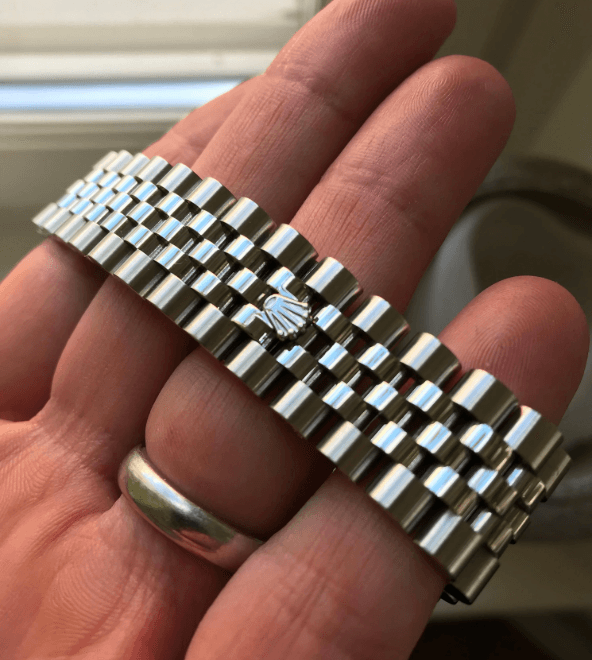
The Jubilee debuted in 1945, created specifically for the original Datejust. Its five-piece link construction is immediately recognizable: smaller, more articulated links that give the bracelet a flowing, textured appearance. The Jubilee drapes across the wrist with more flexibility than the Oyster, which some owners describe as feeling more like fabric than metal.
For decades, the Jubilee was considered a dress bracelet, paired almost exclusively with the Datejust and Day-Date. That changed in 2018 when Rolex released the GMT-Master II "Pepsi" (ref. 126710BLRO) on a Jubilee bracelet. Putting a five-link dress bracelet on a professional sport watch was a statement. It was controversial, it split collector opinion, and it turned out to be enormously popular. The Jubilee Pepsi GMT became one of the most sought-after watches in the entire Rolex catalog.
Modern Jubilee bracelets use an Oysterclasp with concealed folding mechanism and Easylink comfort extension. The clasp is hidden beneath the center link, creating a cleaner visual line along the underside of the wrist compared to the more exposed Oysterlock on the Oyster bracelet. Early Jubilee bracelets had a reputation for feeling less substantial than the Oyster, but current production versions with solid links have eliminated that concern entirely.
One practical consideration: the Jubilee's smaller links can be harder to keep clean. Dirt and grime accumulate between the articulated joints more readily than on the Oyster's larger, flatter surfaces. A soft toothbrush and warm soapy water solve this, but it requires slightly more maintenance attention.
The President Bracelet: Precious Metal Only
The President bracelet exists on exactly two model lines: the Day-Date and certain precious-metal Lady-Datejust configurations. It is never available in stainless steel, which instantly makes it the most exclusive bracelet in the Rolex lineup. Its semi-circular three-piece link design creates a rounded, flowing profile that is unlike anything else Rolex produces.
The name comes from the Day-Date's association with world leaders. When Rolex created the bracelet for the Day-Date's 1956 launch, they called it the President bracelet, and the name eventually became shorthand for the watch itself. Today, saying "President" in a watch context is almost always a reference to the Day-Date on this specific bracelet.
The Crownclasp on modern President bracelets is a concealed folding mechanism that sits completely flush with the surrounding links when closed. The effect is a seamless band of precious metal around the wrist with no visible clasp hardware. Because the entire bracelet is 18k gold or 950 platinum, the weight is substantial. A gold President bracelet alone weighs significantly more than many complete stainless steel watches.
The comfort factor is noteworthy. The rounded link profiles eliminate the hard edges that can sometimes cause pressure points with flat-link bracelets. Many Day-Date owners describe the President bracelet as the most comfortable metal bracelet they have ever worn. The trade-off is that the soft precious metal shows scratches more readily than steel, and the rounded links accumulate fine micro-scratches over time that give the bracelet a lived-in character.
The Oysterflex Bracelet: Rubber Reimagined
Calling the Oysterflex a "rubber strap" undersells what Rolex engineered. Introduced in 2015 on the Yacht-Master, the Oysterflex is a flexible bracelet built around a superelastic metal blade running through the center of each side. The blade is covered by high-performance black elastomer that is resistant to UV, salt water, and chemicals. The result is a strap that is as structurally secure as a metal bracelet but significantly lighter and cooler against the skin.
Inside the strap, a patented longitudinal cushion system uses two small cushions at the clasp end to keep the watch securely positioned on the wrist without the strap needing to be uncomfortably tight. The clasp itself is the same Oysterlock mechanism used on steel sport bracelets, including the Rolex Glidelock micro-adjustment system for on-the-fly sizing changes.
The Oysterflex is currently available only on precious metal models: Yacht-Master, Daytona, Day-Date, and Sky-Dweller in gold or platinum. Pairing a precious metal case with an elastomer strap creates a distinctive sport-luxury combination. The Daytona in Everose gold on Oysterflex, in particular, has become one of the most visually striking configurations in the current catalog.
The Oysterflex does wear out over time, unlike metal bracelets that last essentially forever with proper care. Rolex designs it to be replaceable, and the replacement cost is moderate relative to the price of the watches it accompanies. Plan on replacing it every five to ten years with regular wear.
How Bracelet Choice Affects Resale Value
On the secondary market, bracelet type creates measurable price differences. The GMT-Master II "Batman" on Jubilee (ref. 126710BLNR) has historically traded at a premium over the same colorway when it was offered on Oyster, though buyer preferences shift over time. The "Pepsi" GMT on Jubilee also commands strong premiums.
Bracelet condition matters too. Stretch in vintage bracelets (looseness from decades of link wear), scratches on polished surfaces, and replaced clasps all affect value. Original bracelet and clasp date codes matching the production year of the watch add meaningful value to pre-owned pieces. When evaluating a pre-owned Rolex, always ask whether the bracelet is original to the watch or a later replacement. A replacement bracelet on a vintage model can reduce value by $1,000 to $3,000 or more.
Choosing the Right One
The Oyster is the safe, versatile choice that works in every context. The Jubilee adds refinement and flexibility without sacrificing durability. The President signals precious metal exclusivity and offers exceptional comfort. The Oysterflex suits active lifestyles and warm climates with a sport-luxury aesthetic.
If you can, try the same watch on different bracelets at an authorized dealer before deciding. The difference in feel, weight, and visual character is significant enough that it can change your preference entirely.
For more on how bracelet choice interacts with specific models, read our GMT-Master II Pepsi, Batman, and Sprite guide and our Datejust vs Day-Date comparison.
Think You Know Rolex?
Put your knowledge to the test with the free 12-question Chronodex challenge. No account required. See how you rank against thousands of other enthusiasts.
Take the Free ChallengeThis article is for educational purposes only. Chronodex is not affiliated with, endorsed by, or sponsored by Rolex SA, Rolex USA, or any of their subsidiaries. All brand names are used for educational and identification purposes only.