March 25, 2026 · 8 min read
How to Spot a Fake Rolex: 7 Authentication Points Most People Miss
Learn the key authentication checkpoints that separate genuine Rolex watches from counterfeits, including cyclops magnification, rehaut engraving, and more.
Rolex counterfeits have gotten significantly better over the past decade. The cheap knockoffs with misspelled dials are still out there, but the high-end replicas now use sapphire crystals, ceramic bezels, and even cloned movements. If you are buying pre-owned, knowing what to look for is no longer optional. It is essential.
Here are seven authentication points that most buyers overlook, and that even experienced collectors sometimes miss.
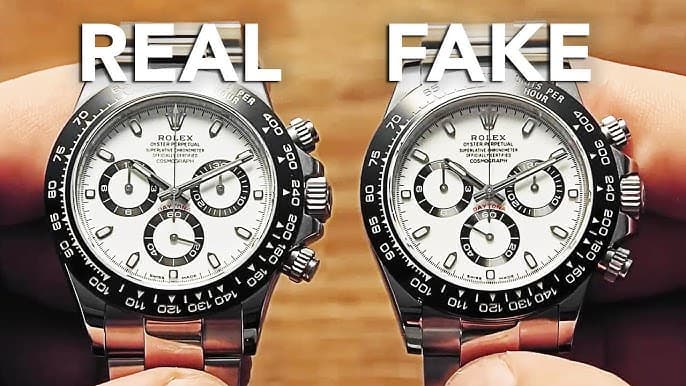
1. Cyclops Magnification
The magnifying lens over the date window on a genuine Rolex provides 2.5x magnification. The date should appear large and fill most of the cyclops window. On fakes, the magnification is often closer to 1.5x, making the date look small and distant. Hold the watch at arm's length. If you have to squint to read the date through the cyclops, that is a red flag.
2. Rehaut Engraving
Starting around 2007, Rolex began laser-engraving "ROLEX" repeatedly around the inner ring of the dial (the rehaut). On a genuine watch, these letters are perfectly aligned, evenly spaced, and crisp. The serial number is also engraved at the 6 o'clock position on the rehaut.
Fakes often have slightly uneven spacing, blurry edges, or letters that don't line up with the dial markers. You will need a loupe to check this properly. A 10x jeweler's loupe costs a few dollars and can save you thousands.
3. Luminous Material (Lume)
Modern Rolex watches use Chromalight or LumiNova on the hands and hour markers. Chromalight glows blue in the dark, while older LumiNova and Super-LumiNova glow green. The lume plots should be perfectly uniform in size, shape, and application. On counterfeit watches, lume application is often sloppy, with uneven edges, visible bubbles, or inconsistent thickness.
Take the watch into a dark room after exposing it to bright light for thirty seconds. The glow should be even across all markers and both hands. Uneven brightness or different colors between markers and hands is a warning sign.
4. Weight and Feel
A genuine Rolex is made from 904L stainless steel (called Oystersteel by Rolex), which is denser and more corrosion-resistant than the 316L steel used in most counterfeits. Pick up a known genuine Rolex and then pick up the watch in question. The difference in heft is often noticeable, though high-end replicas are closing this gap.
Beyond weight, pay attention to the bracelet. Genuine Rolex bracelets feel solid with zero lateral play. The clasp should close with a satisfying, precise click. Rattling, looseness, or a hollow feeling in the links suggests a fake.
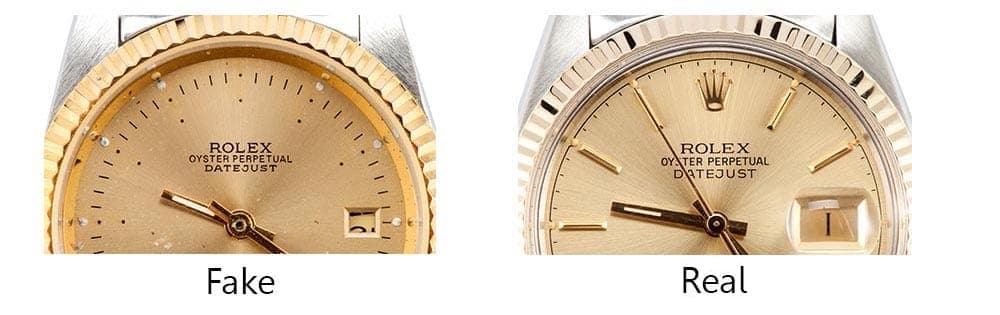
5. Movement Sound
Hold the watch up to your ear in a quiet room. A genuine Rolex uses a perpetual movement that produces a smooth, almost inaudible hum. You might hear a very faint whirring from the rotor, but nothing loud.
Many counterfeits use cheaper automatic movements or modified movements that produce a louder, more rhythmic ticking. If you can clearly hear distinct "tick tick tick" sounds, something is wrong. This test is not definitive on its own, since some high-end replicas use genuine ETA movements, but it is a useful quick check.
6. Dial Printing Quality
Rolex dials are printed with extraordinary precision. Under magnification, every letter should have perfectly smooth edges with no bleeding, fuzzy outlines, or inconsistent ink density. The "ROLEX" text beneath the 12 o'clock marker and the model name above 6 o'clock should be sharp enough to cut glass, figuratively speaking.
Look especially at the small text. The "Swiss Made" text at the very bottom of the dial is a common failure point on counterfeits. On newer genuine models, this reads "SWISS MADE" in a specific font and spacing that is difficult to replicate exactly.
7. Serial and Model Number Engravings
On modern Rolex watches (post-2005), the serial number is engraved on the rehaut at 6 o'clock. On older models, it is engraved between the lugs at 6 o'clock (you need to remove the bracelet to see it). The model number sits between the lugs at 12 o'clock.
Genuine engravings are made with a very fine laser or diamond-point process. They are thin, precise, and slightly reflective. Counterfeit engravings tend to be deeper, thicker, or have a sandy, acid-etched appearance. If the engraving looks like it was stamped or has rough edges, proceed with extreme caution.
The Bottom Line
No single checkpoint will catch every fake. The best approach is to check all seven points and look for the overall picture. A genuine Rolex passes every test. A fake usually fails at least two or three.
The most important thing you can do is educate yourself before you shop. Understanding what to look for, and why it matters, is the difference between a smart purchase and an expensive mistake.
For a deeper look at the highest-quality counterfeits on the market today, read our guide on Rolex super clones and why modern fakes are nearly undetectable. You can also strengthen your authentication skills by learning how to look up Rolex serial numbers and how to decode Rolex reference numbers.
Think You Know Rolex?
Put your knowledge to the test with the free 12-question Chronodex challenge. No account required. See how you rank against thousands of other enthusiasts.
Take the Free ChallengeThis article is for educational purposes only. Chronodex is not affiliated with, endorsed by, or sponsored by Rolex SA, Rolex USA, or any of their subsidiaries. All brand names are used for educational and identification purposes only.