April 8, 2026 · 8 min read
Rolex Serial Number Lookup: How to Date Your Watch
Learn where to find your Rolex serial number, how the numbering system works, and how to use it to determine your watch's production year and verify authenticity.
Every Rolex ever produced has a unique serial number. That number tells you when the watch was manufactured, helps verify its authenticity, and plays a critical role in service history and insurance documentation. If you own a Rolex or are looking to buy one pre-owned, knowing how to find and interpret the serial number is one of the most practical skills you can have.
Where to Find the Serial Number
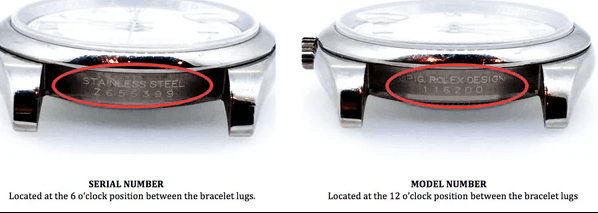
The location of the serial number depends on when the watch was made. On Rolex watches produced before approximately 2005, the serial number is engraved between the lugs on the 6 o'clock side of the case. To see it, you need to remove the bracelet or strap. The model (reference) number sits in the same position on the 12 o'clock side.
Starting around 2005, Rolex began engraving the serial number on the inner bezel ring (the rehaut) at the 6 o'clock position. On these newer models, you can read the serial number without removing the bracelet, though you will need a loupe or magnifying glass to see it clearly. The word "ROLEX" is also laser-engraved repeatedly around the rest of the rehaut.
During the transition period (roughly 2005 to 2008), some watches have the serial number engraved in both locations. If you find it in both places, the numbers should match exactly.
How the Serial Number System Works
Rolex serial numbers have gone through several formats over the decades. Understanding the system helps you date a watch with reasonable accuracy.
From the 1920s through the mid-1950s, Rolex used purely numeric serial numbers that increased sequentially. These early numbers were relatively short, starting with five digits and gradually growing longer as production scaled up.
Starting in 1987, Rolex introduced a letter prefix system. The letter at the beginning of the serial number corresponds to a specific production year or range. For example, serial numbers starting with "R" correspond to approximately 1987, while "E" corresponds to around 1990, "W" to roughly 1994 to 1995, and "A" to approximately 1999.
This letter prefix system continued through the alphabet (though not in strict alphabetical order) until around 2010. After that, Rolex switched to a randomized serial number system, making it impossible to determine the production year from the serial number alone on newer watches.
Dating a Watch by Serial Number
For watches made between 1926 and 2010, the serial number can help you determine the approximate production year. There are well-known reference tables available that map serial number ranges (for numeric serials) and letter prefixes (for the 1987 to 2010 era) to their corresponding production years.
Keep in mind that these dates are approximate. A serial number assigned in late 2003 might correspond to a watch that was actually assembled and shipped in early 2004. Production, engraving, and delivery do not always happen in the same calendar year.
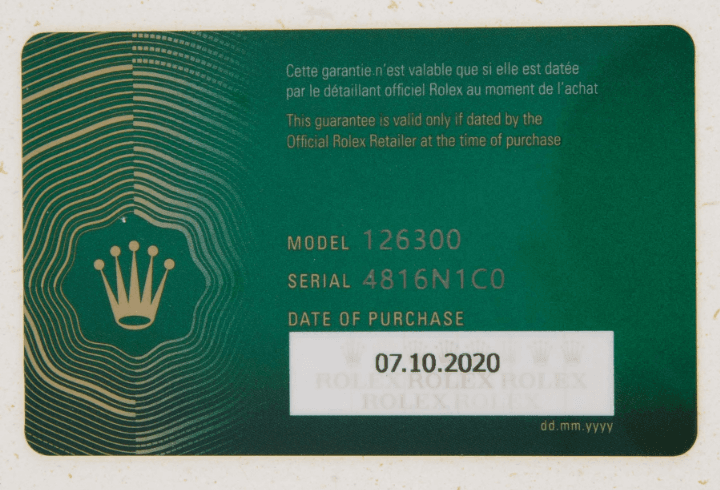
For watches produced after 2010 with randomized serials, the only reliable way to determine the production date is through Rolex service records, the original purchase receipt, or the warranty card (now a green card with a QR code on newer models).
What the Serial Number Cannot Tell You
The serial number identifies the individual watch, but it does not encode the model, the materials, the dial color, or any other specification. That information lives in the reference number, which is a separate identifier. The reference number tells you the model (Submariner, Datejust, etc.), the bezel type, the case material, and sometimes the dial type.
The serial number also does not function as a theft database lookup. While Rolex does maintain internal records, they do not offer a public database where you can enter a serial number and see if a watch has been reported stolen. Some third-party services and insurance companies maintain their own registries, but coverage is not universal.
Using Serial Numbers for Authentication
The quality of the serial number engraving itself is one of the strongest authentication indicators on a Rolex. On a genuine watch, the engraving is done with extreme precision. The characters are thin, clean, and slightly reflective when they catch the light. They are engraved with a diamond-tip process or fine laser, depending on the era.
Counterfeit watches often have serial number engravings that are too deep, too thick, or have a sandy, acid-etched quality. Some fakes use a dot-matrix pattern that is visible under magnification. Others engrave legitimate Rolex serial numbers from a completely different model, which is why cross-referencing the serial number with the reference number and production year is important.
Recording and Protecting Your Serial Number
If you own a Rolex, document the serial number and store it separately from the watch. Take a clear photo of the engraving with good lighting and magnification. Keep a written record with your insurance documents and purchase receipts.
This information is essential if the watch is ever lost, stolen, or needs to be sent in for service. Rolex Authorized Service Centers use the serial number to pull up the watch's history and verify its identity.
One important note: be cautious about sharing your serial number publicly, such as in social media photos of your watch. While the risk is low, a fraudster could potentially use a known genuine serial number to add false credibility to a counterfeit piece.
The Bottom Line
The serial number is one of the most important identifiers on any Rolex. It connects the watch to its production date, helps verify authenticity, and serves as the primary record for service and insurance purposes. Whether you are buying your first Rolex or evaluating a pre-owned piece, knowing where to find the serial number, how to read it, and what to look for in the engraving quality gives you a meaningful advantage.
Think You Know Rolex?
Put your knowledge to the test with the free 12-question Chronodex challenge. No account required. See how you rank against thousands of other enthusiasts.
Take the Free ChallengeThis article is for educational purposes only. Chronodex is not affiliated with, endorsed by, or sponsored by Rolex SA, Rolex USA, or any of their subsidiaries. All brand names are used for educational and identification purposes only.