June 10, 2026 · 9 min read
The Rolex Explorer: From Everest to Your Wrist
Trace the full history of the Rolex Explorer from the 1953 Everest expedition through every major reference to the modern 124270.
The Rolex Explorer holds a unique position in the Rolex catalog. It is not the most expensive model. It is not the flashiest. But it may be the most historically significant watch Rolex has ever produced. Born from one of the greatest human achievements of the twentieth century, the Explorer has evolved from a rugged expedition tool into one of the most refined everyday watches available. Here is the full story.
The Everest Connection
On May 29, 1953, Sir Edmund Hillary and Tenzing Norgay became the first confirmed climbers to reach the summit of Mount Everest. Rolex Oyster Perpetual watches accompanied the British expedition, and the successful ascent gave Rolex an association with exploration and achievement that they have leveraged ever since.
Later that same year, Rolex released the Explorer, reference 6350. The timing was no coincidence. The Explorer was designed to embody the qualities proven on Everest: reliability under extreme conditions, legibility in poor light, and toughness against shocks, temperature swings, and altitude.
It is worth noting that the exact watches worn on the summit remain a topic of historical debate. But the connection between Rolex, Everest, and the Explorer name became cemented in public consciousness immediately after the expedition's triumph.
The Reference 1016: A Legend
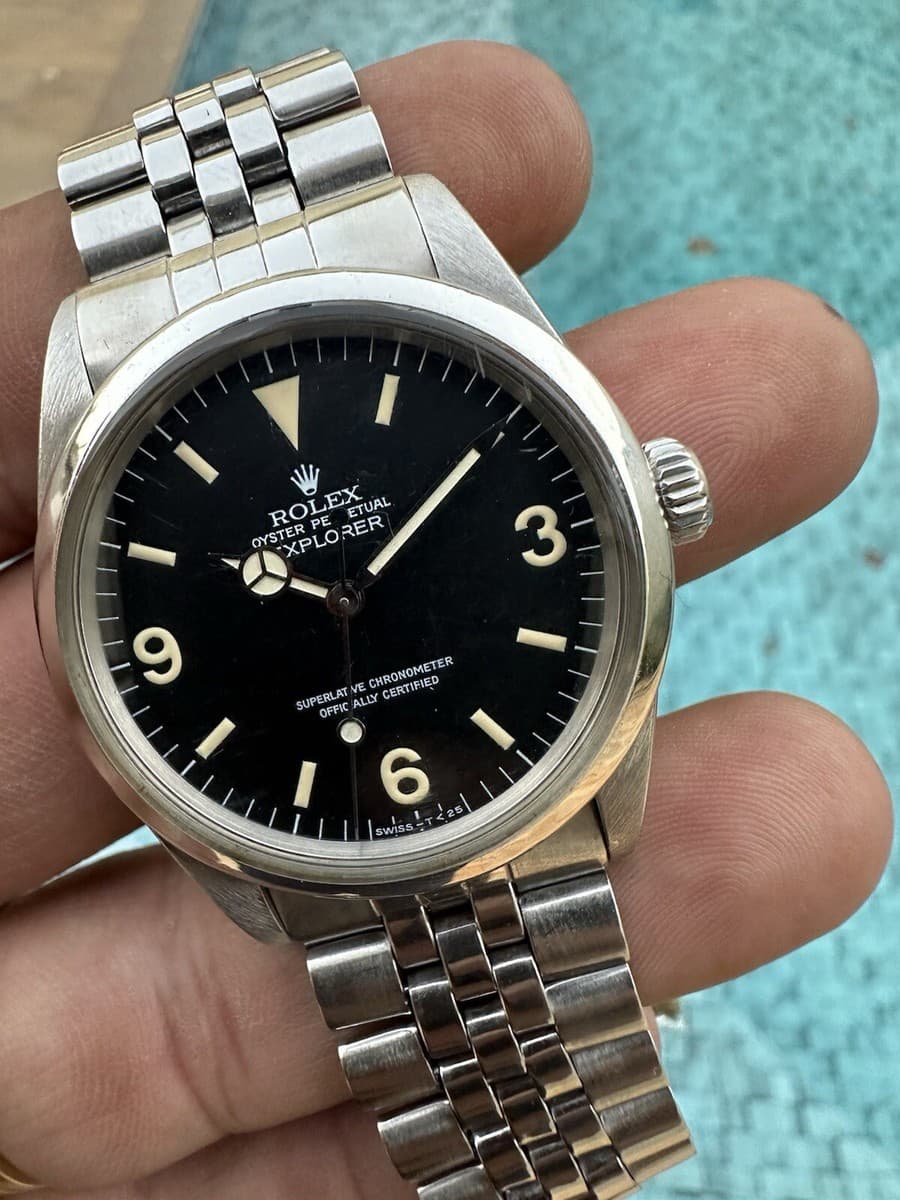
In 1963, Rolex introduced the reference 1016, which would become one of the longest-running references in the company's history, staying in production until 1989. The 1016 established the Explorer's signature design language: a 36mm Oyster case, black dial with the 3-6-9 Arabic numeral configuration at the quarter hours, and Mercedes-style hands with luminous fill.
Over its 26-year production run, the 1016 went through several subtle dial variations. Early examples featured gilt (gold-toned) dials with glossy lacquer finishes. Later versions switched to matte dials. The very latest examples used a "lollipop" lume plot at 12 o'clock. These dial variations create a rich landscape for vintage collectors, with gilt dial examples commanding the highest premiums.
The 1016 is widely considered one of the greatest tool watches ever made. Its simplicity, proportions, and no-nonsense design philosophy continue to influence modern watchmaking.
The Reference 14270 and 114270
When the 1016 was finally retired in 1989, Rolex replaced it with the reference 14270. This update brought a sapphire crystal (replacing the acrylic crystal of the 1016), updated lume material, and a slightly refined case shape. The 36mm diameter remained unchanged.
In 2001, the 14270 gave way to the reference 114270, which continued the same fundamental design with minor refinements to the dial and movement. Throughout these references, Rolex maintained the Explorer's core identity: a clean, readable, 36mm watch with the 3-6-9 dial configuration.
The Controversial 39mm: Reference 214270
In 2010, Rolex made a change that divided the Explorer community. The reference 214270 increased the case size from 36mm to 39mm. At the same time, the initial version omitted the numerals' lume filling, which many felt betrayed the Explorer's tool watch heritage. Rolex addressed this in a later update (sometimes called the Mark II dial), restoring the lumed 3-6-9 numerals.
The size increase was part of a broader trend across the watch industry toward larger cases. But for Explorer purists who valued the original 36mm proportions, the 39mm felt like a compromise. The 214270 was a capable watch in its own right, but it sparked years of debate about whether Rolex had lost the plot with one of their most historically important models.
The Return to 36mm: Reference 124270
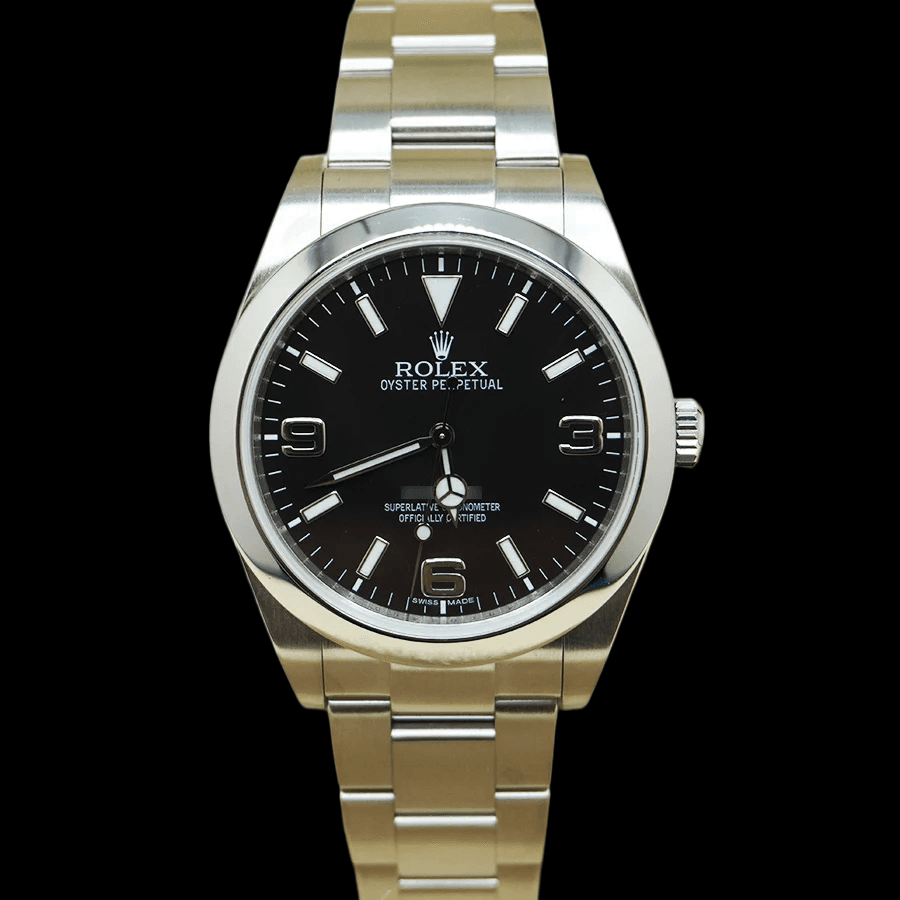
In 2021, Rolex answered the critics. The reference 124270 brought the Explorer back to 36mm while equipping it with the modern caliber 3230 movement (the no-date sibling of the 3235). This meant a 70-hour power reserve, the Chronergy escapement, and Parachrom hairspring in the classic Explorer size that collectors had been requesting for over a decade.
The 124270 was met with near-universal praise. It combined everything collectors loved about the original Explorer proportions with the performance benefits of Rolex's latest movement technology. The case finishing was excellent, the dial was sharp and legible, and the overall package felt like Rolex had listened to its most dedicated fans.
The Explorer II: A Different Animal
It is important to distinguish between the Explorer and the Explorer II. Introduced in 1971 as the reference 1655, the Explorer II was designed for spelunkers and polar explorers who needed to track a second time zone and distinguish between day and night in environments without natural light.
The Explorer II features a fixed 24-hour bezel and an additional GMT hand. It is a larger, more complex watch than the Explorer and serves a fundamentally different purpose. While both carry the Explorer name, they are distinct product lines with separate histories and collector communities.
Why the Explorer Endures
In a world of increasingly large and complicated watches, the Explorer's appeal lies in restraint. It does exactly one thing: tell the time. It does this with exceptional legibility, in a size that fits virtually any wrist, with build quality that will outlast its owner. There is no date window to interrupt the dial symmetry. No rotating bezel to add complexity. No chronograph pushers to catch on sleeves.
The Explorer represents Rolex's core philosophy distilled to its purest form. It is the watch equivalent of a perfectly tailored suit: simple enough to be overlooked by those who do not know what to look for, and immediately recognized by those who do.
From the slopes of Everest to the wrists of collectors worldwide, the Explorer has earned its place as one of the most important watches in horological history. Its story is far from over.
Think You Know Rolex?
Put your knowledge to the test with the free 12-question Chronodex challenge. No account required. See how you rank against thousands of other enthusiasts.
Take the Free ChallengeThis article is for educational purposes only. Chronodex is not affiliated with, endorsed by, or sponsored by Rolex SA, Rolex USA, or any of their subsidiaries. All brand names are used for educational and identification purposes only.