June 24, 2026 · 9 min read
The Paul Newman Daytona: How a $300 Watch Became Worth $20 Million
The story of how the Rolex Cosmograph Daytona went from unwanted chronograph to the most coveted vintage watch in the world, driven by Paul Newman and collector obsession.
In 1968, you could buy a Rolex Cosmograph Daytona for around $300 at any authorized dealer. No waitlist. No premium. Most jewelers had trouble selling them. Fast forward to 2017, and a single Paul Newman Daytona sold at Phillips auction for $17.75 million, making it the most expensive wristwatch ever sold at the time. The question collectors have been asking ever since: how did an overlooked chronograph become the holy grail of watch collecting?
The Original Cosmograph Daytona
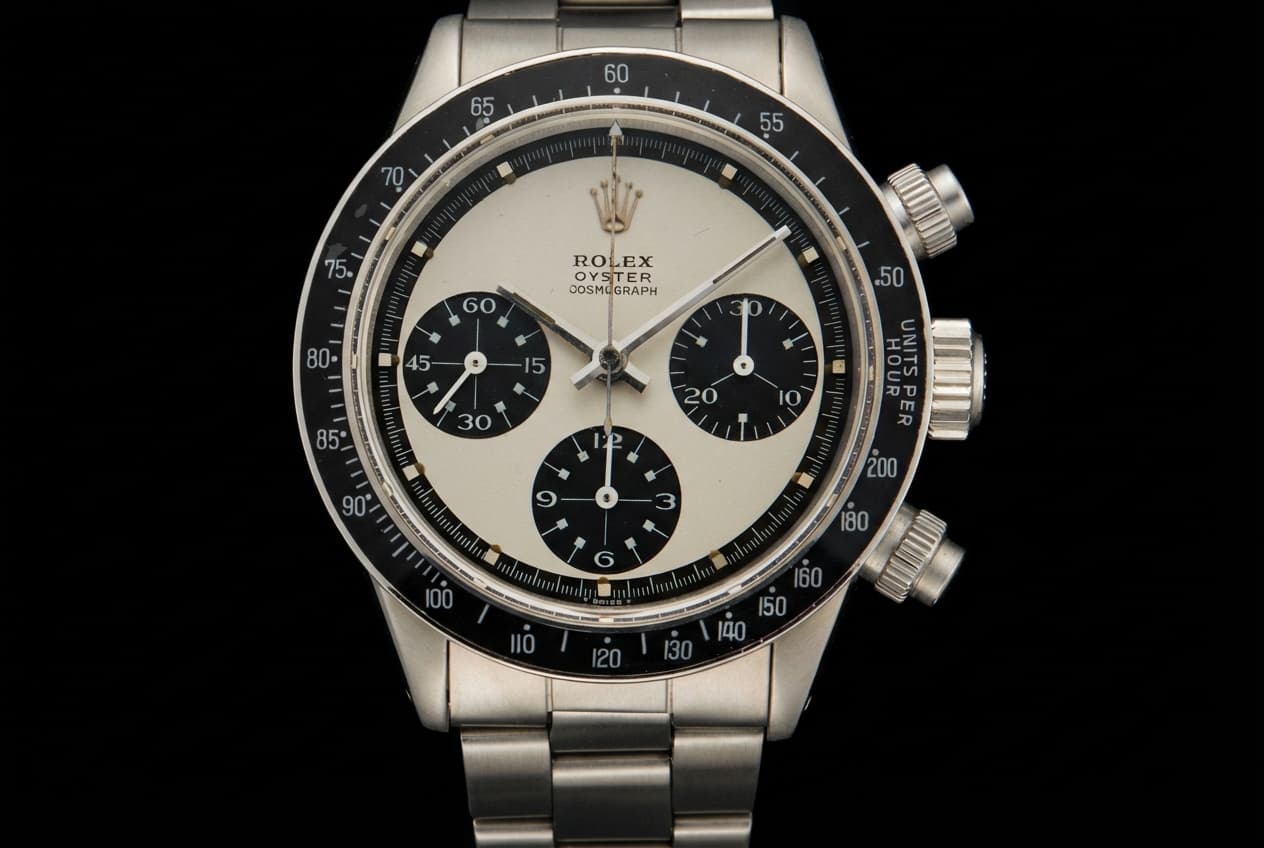
Rolex introduced the Cosmograph in 1963 with reference 6239. It was a manual-wind chronograph with a tachymeter scale on the bezel, designed for timing speeds and lap times. The name "Daytona" came from Rolex's sponsorship of the 24 Hours of Daytona race, though early models did not always carry the Daytona name on the dial. The watch used the Valjoux 72 movement, a reliable hand-wound caliber that was common among Swiss chronographs of the era.
During the 1960s and 1970s, the Cosmograph Daytona was far less popular than the Submariner or GMT-Master. Buyers preferred automatic movements, and the Daytona required manual winding. It sat in display cases. Dealers offered discounts. This lack of demand is precisely what makes early references so rare today. Many were sold, worn hard, and never preserved because nobody thought they would be valuable.
What Makes a Dial a "Paul Newman" Dial?
The term "Paul Newman dial" refers to a specific exotic dial variant used on certain Daytona references from the mid-1960s through the late 1970s. These dials have several distinguishing features: an Art Deco style font for the hour markers, small square markers at the outer edge of the subdials, a contrasting color scheme between the main dial and subdials, and a distinctive minutes/seconds track with hash marks instead of dots.
The key references that came with Paul Newman dials include the 6239, 6241, 6262, 6263, 6264, and 6265. Not every Daytona from this era had the exotic dial. Standard dials were also available, and those watches, while still valuable, trade for significantly less than their Paul Newman dial counterparts. A standard dial ref. 6239 might sell for $100,000 to $200,000, while a Paul Newman dial version of the same reference could command $500,000 or more depending on condition.
Why Paul Newman?
The actor and racing enthusiast Paul Newman wore a Rolex Daytona ref. 6239 with an exotic dial for decades. His wife Joanne Woodward gave it to him in the late 1960s, reportedly with an engraving on the caseback. Newman wore the watch constantly, both on and off the racetrack, and it became closely associated with his image.
Italian watch dealers in the 1980s began using the term "Paul Newman" to describe Daytonas with the exotic dial configuration. The name stuck. As collecting culture grew throughout the 1990s, the Paul Newman Daytona became the single most coveted reference in all of horology. The combination of a Hollywood legend, racing heritage, limited surviving examples, and a genuinely distinctive dial created a perfect storm of collector demand.
The Record-Breaking Auction
In October 2017, Paul Newman's personal Daytona (the actual watch from his wrist) sold at Phillips in New York for $17,752,500 including buyer's premium. It was the most expensive wristwatch ever sold at auction at the time. The watch had been given by Newman to his daughter's boyfriend, James Cox, in the early 1980s, and had remained largely out of public view until it was consigned for sale. Part of the proceeds went to charity, consistent with Newman's lifelong philanthropic work.
That record has since been surpassed by other watches, but the Paul Newman Daytona remains the single most iconic lot in modern auction history. It proved that the right combination of provenance, rarity, and cultural significance can push a wristwatch into fine art territory.
Values of Paul Newman Daytonas Today
Even without celebrity provenance, Paul Newman dial Daytonas command enormous prices. A ref. 6239 with an original Paul Newman dial in good condition typically trades between $300,000 and $800,000. The rarest variants, like the ref. 6263 with a "Big Red" Daytona inscription on a Paul Newman dial, can exceed $1 million. Condition of the dial is everything. Original, unrestored dials with even patina bring the highest premiums.
The most critical factor in valuation is dial originality. Restored dials, replacement dials, and "franken" watches (assembled from parts of multiple watches) trade at steep discounts. Serious collectors rely on provenance documentation, service records, and expert authentication to verify that a Paul Newman dial is original to the case and has not been swapped or refinished.
Modern Daytonas and the Paul Newman Legacy
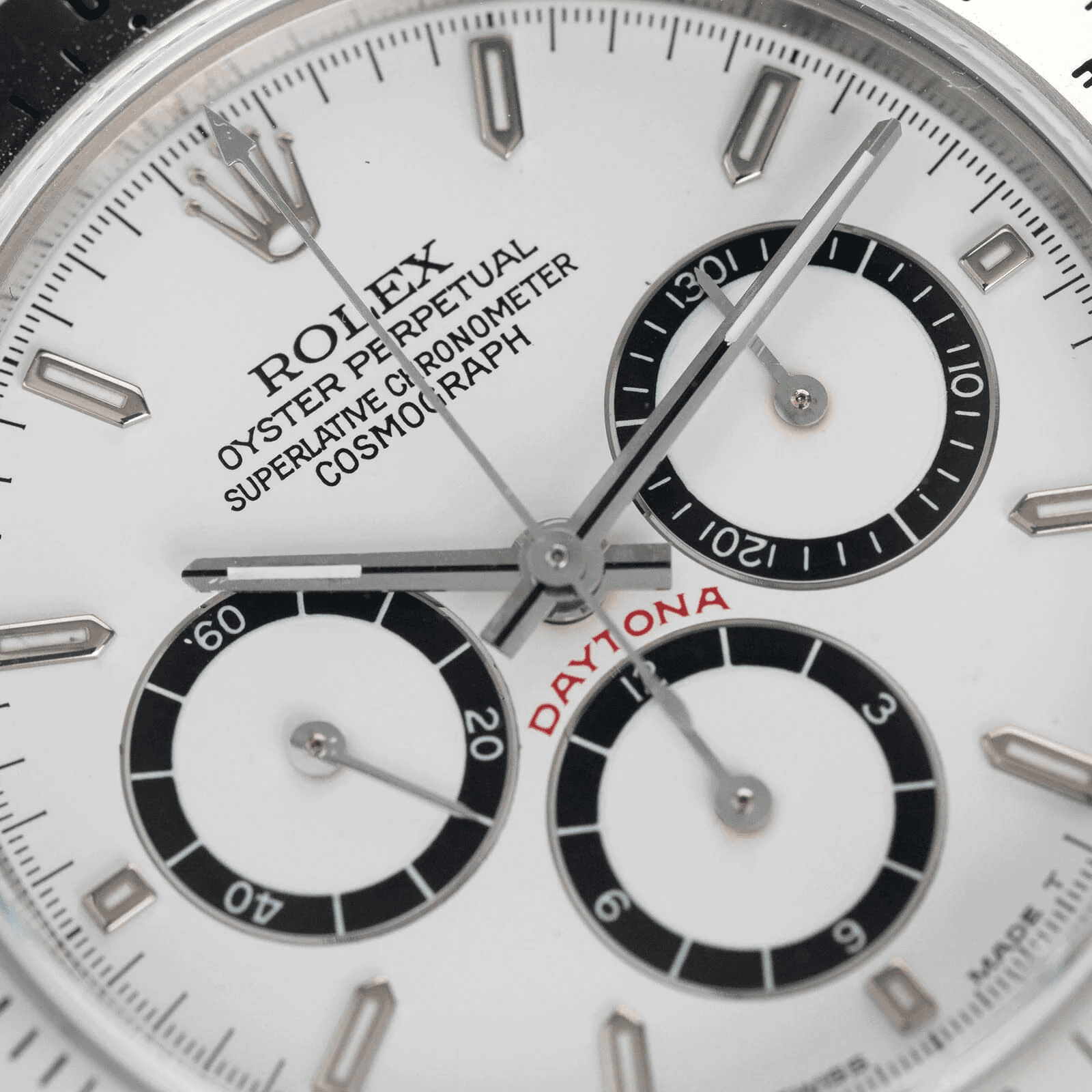
Rolex has nodded to the Paul Newman aesthetic in several modern releases. The ref. 116518LN and ref. 116519LN in precious metals on Oysterflex bracelets feature dial designs that echo the exotic dial look. In 2023, Rolex released the ref. 126529LN "Le Mans" Daytona with a design that many saw as a direct tribute to the vintage Paul Newman aesthetic.
These modern interpretations are not Paul Newman Daytonas in the collector sense. They do not have the hand-wound movements, the pump pushers, or the vintage charm that define the originals. But they demonstrate how deeply the Paul Newman Daytona has influenced Rolex's own design language and the broader market.
Lessons for Collectors
The Paul Newman Daytona story teaches several important lessons about watch collecting. First, popularity is not permanent. The watches that sit unsold today may become the icons of tomorrow. Second, cultural association matters. Newman's connection to the watch amplified its value in ways that no marketing campaign could replicate. Third, originality and condition are non-negotiable at the highest levels of collecting. A perfect example with full provenance will always outperform a questionable one.
Whether you are a serious collector or simply fascinated by how a $300 tool watch became a $20 million artifact, the Paul Newman Daytona is a story worth understanding. It sits at the intersection of mechanical engineering, design, celebrity culture, and the human tendency to assign extraordinary value to objects with the right story behind them.
Think You Know Rolex?
Put your knowledge to the test with the free 12-question Chronodex challenge. No account required. See how you rank against thousands of other enthusiasts.
Take the Free ChallengeThis article is for educational purposes only. Chronodex is not affiliated with, endorsed by, or sponsored by Rolex SA, Rolex USA, or any of their subsidiaries. All brand names are used for educational and identification purposes only.